
Episode 12: Ego Development Part 5 -
The Construct Aware & Transpersonal Stages
Tiers of Development in O’Fallon’s STAGES Model
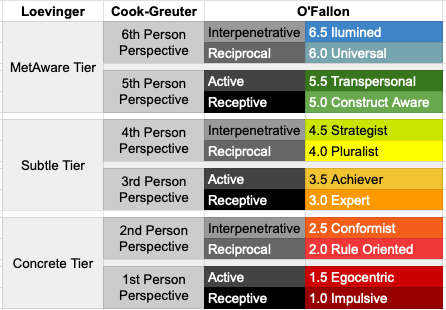
The 5th Person Perspective is a shift into a new tier, something we haven’t yet unpacked in our series that we think will help you “see” more fully what this stage of development is about. But first, here’s a visual:
Terri O'Fallon's STAGES model organizes human development into three primary tiers—Concrete, Subtle, and MetAware—each representing a progressively more complex way of perceiving and interacting with reality. These tiers build upon foundational work in ego development by Jane Loevinger and Susanne Cook-Greuter, integrating insights from integral theory (e.g., Ken Wilber's quadrants) and empirical research. Each tier encompasses four stages, reflecting shifts in how individuals process objects of awareness: from tangible, physical elements in the Concrete tier to intangible ideas and relationships in the Subtle tier, and finally to meta-level awareness of constructs themselves in the MetAware tier. Development isn't linear or hierarchical in value—one tier isn't "better" than another—but later tiers include and transcend earlier ones, offering broader perspectives while retaining access to prior capacities.
To illustrate using the house metaphor from our podcast episode: Imagine spending your life inside a house you've built room by room, adding walls, furniture, and decorations based on what felt safe and useful at the time. The tiers represent fundamental shifts in how you relate to this house (which is a metaphor for ho you relate to yoruself).
Concrete Tier (Stages 1.0–2.5: Impulsive, Egocentric, Rule-Oriented, Conformist)
The Concrete tier corresponds to early development, typically from infancy through adolescence, though adults can operate from here in certain contexts. Here, awareness focuses on tangible, sensory objects—what you can see, touch, hear, smell, or taste. Reality is immediate and literal; abstract concepts like time, emotions, or societal systems are not yet fully grasped as separate from physical experience. Perspectives are first- and second-person: "me" (egocentric) and "you and me" (beginning to consider others concretely).
In the house metaphor: When really young (first- and early second-person perspectives), you learn the basic rules of how a house works—you can't run through walls, and when you make a mess, you have to clean it up. Later, you learn to live with others in the house and behave when visiting others' houses. You have a role (e.g., child), and you understand others' concrete roles (e.g., mom, dad, teacher). Everything is about physical boundaries, immediate needs, and group norms enforced through tangible rewards or punishments.
From O'Fallon's manual: This tier emphasizes concrete operations (drawing from Piaget), where individuals deal with singular, physical objects or groups of them. Time is present-focused or rooted in the immediate past; space is limited to one's body or immediate environment (egocentric to ethnocentric). Shadows here often involve unmet basic needs, leading to rigid rule-following or fear of exclusion.
Subtle Tier (Stages 3.0–4.5: Expert, Achiever, Pluralist, Strategist)
The Subtle tier marks a shift to post-conventional awareness, typically emerging in early adulthood. Objects of awareness become intangible and subtle—ideas, emotions, relationships, values, and systems. Perspectives expand to third- and fourth-person: viewing oneself objectively (third) and recognizing multiple contexts, histories, and interdependencies (fourth). Reality is seen as relational and constructed through culture, psychology, and time.
In the house metaphor (“house” as a synonym for “self” or “ego”): You realize the house's design might not suit you forever. You rearrange furniture for efficiency and harmony, knock down walls to open space, and consider how objects' placement affects the room's subtle "feel" (like feng shui). When visiting others' houses, you notice how their decor and layout influence the experience, and the way their upbringing, socioeconomic status, and cultural influences shape the look and feel of their home. By late Subtle (Strategist), you're attuned to the house's historical evolution and can redesign systems for better flow.
This tier involves formal and post-formal operations, where individuals coordinate multiple subtle objects (e.g., conflicting values or cultural narratives). Time extends to future planning and historical context; space becomes world-centric. Shadows may manifest as over-identification with achievements or relativism.
MetAware Tier (Stages 5.0–6.5: Construct Aware, Transpersonal, Universal, Illumined)
The MetAware tier represents the edge of researched development, rare (less than 1% of adults) and focused on awareness of awareness itself. Objects are meta-level: linguistic constructs, egoic filters, and the processes of meaning-making. Perspectives are fifth- and sixth-person: witnessing the constructed nature of reality (fifth) and experiencing unity beyond ego (sixth). This tier integrates all prior ones but transcends personal boundaries.
In the house metaphor: You step outside the house for the first time, realizing it's a mental construct—a dream created by your mind. Awareness becomes the foundational "constructor" of experience, making the process of reality-building visible and visceral. This is akin to "waking up" in spiritual traditions, where the house (ego) is seen as illusory yet useful.
MetAware involves metasystematic thinking, comparing entire systems and recognizing their partial, anthropocentric nature. Time is timeless or cosmic; space is universal or illumined. Shadows here involve existential futility or detachment. Speculatively, a Unified tier (seventh-person and beyond) may follow, embodying non-dual oneness.
From Ignorance to Mastery: How We Learn Anything and Everything
In Terri O'Fallon's STAGES model, development unfolds through repeating patterns of four learning/being styles—Receptive, Active, Reciprocal, and Interpenetrative—across each tier (Concrete, Subtle, MetAware). These styles reflect how individuals engage with the tier's objects of awareness: from solitary absorption to collective mastery. The latter two styles, Reciprocal and Interpenetrative, mark the "collective" half of each tier, emphasizing relational and integrative dynamics over individual focus. The movement between them is a subtle, one-parameter shift (e.g., from passive to active within the collective orientation), enabling deeper synthesis and preparing for tier transitions.
To illustrate, let's adapt the podcast's analogy of how these repeating patterns emerge through something nearly everyone has experienced: learning to drive a car.
Receptive Orientation
The Receptive way of orienting initiates each tier, marking early entry where the perspective "has" the individual. Awareness is passive and singular, absorbing the tier's objects to learn their contours. It's "had by" the view, with minimal agency—focusing on one concept at a time. Time and space are immediate; shadows involve unmet needs or disorientation from novelty.
In the driving analogy: As a child, you receptively watch adults drive, absorbing basics like steering or braking. You are, quite literally, “along for the ride”. It's passive immersion in the "driving world," building foundational awareness.
From O'Fallon's research, this correlates in Concrete (1.0 Impulsive), it's sensory absorption (e.g., baby's oceanic experience); in Subtle (3.0 Expert), emulating subtle experts; in MetAware (5.0 Construct Aware), drifting in awareness of constructs. This orienting style is the basis for trust that allows for growth, as in bonding or cradling new identities.
Active Orientation
The Active way of orienting shifts to assertive engagement, where individuals "act on" objects with "either/or" thinking—one idea dominates. Agency emerges, experimenting individually to control or pursue desires.
In the driving analogy: You actively practice under close supervision from others who are masters, experimenting with the wheel, pedals, and mirrors—asserting control, making "either/or" choices like "gas or brake," but focused on your individual mastery. When not under close supervision from others, you still must exert large amounts of conscious effort to ensure you continue to “do it right”.
This correlates to Concrete (1.5 Egocentric), it's pursuing wants; in Subtle (3.5 Achiever), goal-driven; in MetAware (5.5 Transpersonal), wielding constructs passionately.
Reciprocal Style
The Reciprocal way of orienting transitions to collective orientation, emphasizing passive mutual exchange—"both/and" relativism, belonging, and agreement to disagree. Awareness holds perspectives in parallel, fostering interdependence without full synthesis.
In the driving analogy: you’re moving beyond the rules of the road, and are attuned to the unwritten ones. You wave to let someone in, you honk if they’re not paying attention, you’re attuned to the subtle flow of traffic and adjust your speed in a way that’s guided beyond the posted speed limit. It's harmonious learning through shared dynamics.
From O'Fallon's works: In Concrete (2.0 Rule-Oriented), group rules; in Subtle (4.0 Pluralist), contextual dialogues; in MetAware (6.0 Universal), universal reciprocity (e.g., oneness states).
Interpenetrative Style (Active-Collective)
The Interpenetrative way of orienting culminates the tier signaling mastery with that' tier’s objects, activating collective synthesis: "one-within-the-other," where elements co-emerge dynamically. Individuals "have" the perspective as a tool, prioritizing ethically and reflecting on trajectories. This prepares for the next tier's Receptive restart.
In the driving analogy: driving becomes an integrated extension of collective rhythm. And, it’s something you no longer need your conscious mind to perform. If you’ve ever gotten in a car to drive somewhere and when you arrived at your destination, you “woke up”, recognizing you have no conscious memory of the drive there. You were on autopilot, yet able to perform an incredibly complex task.
From sources: In Concrete (2.5 Conformist), group fusion; in Subtle (4.5 Strategist), ethical systems; in MetAware (6.5 Illumined), non-dual interpenetration (emptiness/fullness).
5.0 - The Construct Aware Stage: A Deep Dive
The Construct-Aware stage represents the dawn of MetAware development, where the Strategist's (late fourth-person) masterful integration of multiple perspectives, systems, and timelines begins to reveal its own constructed nature. What once felt like a profound grasp of reality—the ability to hold paradox, prioritize among contexts, and orchestrate change—now appears as an elaborate map, not the territory itself. The self, previously experienced as a dynamic, relational process, is now seen as a linguistic and conceptual artifact, built from layers of assumptions, filters, and egoic defenses. This insight pierces the veil of meaning-making: all interpretations, no matter how sophisticated, are partial, anthropocentric, and ultimately illusory. The Construct-Aware individual lives in the tension between the necessity of constructs (to navigate the human realm) and the awareness that they are mere scaffolding, always separating us from direct, unmediated experience. This stage is marked by a profound humility, a playful deconstruction of ego, and an existential ache: the drive to matter collides with the recognition that all striving is rooted in illusion.
Cognition
Cognitively, the Construct-Aware person internalizes a metasystematic view, capable of comparing, coordinating, and critiquing entire systems of thought. They perceive reality as a nested hierarchy of constructs: personal narratives embedded in cultural myths, which are shaped by historical epochs, all filtered through the limits of human language and perception. Paradox and ambiguity are not just tolerated but embraced as essential truths—values come in polarities (e.g., independence vs. interdependence), and attempting to resolve them only creates new distortions. Truth is no longer approximated through better models (as in the Strategist stage) but recognized as inherently partial and perspectival. Geo- and anthropocentric biases become glaring: "My most ‘enlightened’ view is still bound by my biology, culture, and epoch." This leads to a fascination with epistemology—how do we know what we know?—and a shift from linear logic to holistic, embodied awareness. Insights arise from non-rational sources like dreams, intuition, meditation, and somatic signals, which are integrated without needing to "prove" them. However, without yet transcending the personal realm, this awareness can foster a sense of futility: if all meaning is constructed, why construct at all? The shadow here is over-intellectualization or cynical detachment, where deconstruction becomes an end in itself, stalling action.
Relationships
Relationally, the Construct-Aware individual seeks connections that honor the constructed nature of self and other. Others are embraced not just as unique beings (as in Strategist) but as co-participants in a shared illusion of separation. Empathy extends beyond immediate contexts to a global-historical perspective, appreciating radically different ways of life as valid expressions within the human drama. The "other" includes ancestors, future generations, and even non-human entities, fostering a commitment to service with humility: "We are all mortals needing maps to matter." This fuels advocacy for systemic transformation, but with a lighter touch—less about "fixing" through strategy and more about witnessing and midwifing evolution. Shadows emerge in the form of ironic exclusion: the drive to deconstruct hierarchies can lead to dismissing those at earlier stages as "unenlightened," or withdrawing into solitary reflection to avoid the messiness of human interaction. Intimacy becomes playful and raw, with less need to impress; conflicts are seen as opportunities to expose egoic filters. The Golden Rule evolves into "meet others where they are, knowing that 'where they are' is a construct we both co-create," promoting tolerance but risking passive avoidance of necessary confrontation.
Internal Experience
Internally, the self feels embedded in history and multiple cultural contexts, no longer a coherent narrative but a fluid matrix of influences. Emotions and thoughts are observed as arising from deeper constructs—defenses, shadows, and yearnings for meaning. This stage brings a vivid awareness of the ego's "desperate" need to shield itself through symbol-mediated reality, leading to stream-of-consciousness reflections and fundamental questions: "Who is the 'I' that constructs the self?" Authenticity is raw and unpolished; there's less polishing of one's "best side." Positive expressions include accepting paradox with humor, committing to growth amid existential uncertainty, and a sense of liberation from earlier certainties. However, anxieties center on the limits of rational knowing: the fear that no abstraction can bridge the gap to non-duality, or that life's finitude renders all efforts absurd. Defenses may manifest as intellectual elitism, relentless questioning of definitions, or a depressive "to heck with it" relativism. Meditation and introspection deepen, revealing the observer as observable, but this can induce vertigo—a hall of mirrors where self-inquiry loops endlessly without resolution.
Professional Life
Professionally, Construct-Aware individuals thrive in roles that demand metasystematic thinking, such as consulting, research, philosophy, or innovative leadership in complex organizations. They excel at deconstructing outdated paradigms, facilitating breakthroughs in fields like sustainability, AI ethics, or organizational development by highlighting hidden assumptions and polarities. Aligned with postmodern and integral thinkers, they view organizations as living systems embedded in broader historical and cultural narratives, questioning not just processes but the very frames that define "success." In teams, they foster playful exploration, encouraging colleagues to embrace ambiguity and integrate non-rational insights. Leadership is humble and service-oriented, prioritizing long-term evolutionary impact over immediate wins; they may mentor others in vertical development, helping them see their own constructs. Strengths include a global-historical perspective, tolerance for complexity, and the ability to coordinate multiple systems without attachment to any one. However, challenges arise from over-deconstruction: they may paralyze decision-making with endless meta-analysis, appear aloof or overly abstract to conventional colleagues, or drift toward the fringes of institutions, feeling like mavericks in a world that values certainty. In high-stakes environments, their relativistic stance can frustrate delivery-focused cultures, leading to perceptions of them as "too philosophical" or ineffective. Developmentally, they benefit from practices like owning their shadow (e.g., intellectual arrogance), translating insights into actionable strategies, and bridging personal constructs with collective needs—evolving from critique to creative reconstruction.
Pressures that Cause Construct-Aware Individuals to Shift into the Next Stage
The transition from early to late fifth-person perspective is driven by an intensifying confrontation with the limits of personal, symbol-mediated reality. Accumulating pressures expose the Construct-Aware stage's reliance on deconstruction as yet another construct, propelling toward a transpersonal, unitive awareness.
A profound sense of separation from non-duality emerges as an ache: despite metasystematic mastery, the individual feels perpetually distanced from direct experience by layers of language and ego. This fosters a longing for embodiment beyond abstraction—"I see the illusions, but how do I live beyond them?"
Overwhelmed by the futility of meaning-making, the psyche tires of endless deconstruction. The playful paradox that once liberated now feels like a cage: "If all is relative and partial, how do I commit to anything without delusion?" This vertigo demands a new ground—one that includes but transcends the personal realm.
Existential predicaments intensify: mortality, the human yearning to matter, and the absurdity of striving become visceral. Service to others feels hollow if rooted in egoic maps; a deeper call arises to surrender constructs altogether.
Awareness of geo- and anthropocentric biases deepens, revealing even "enlightened" views as human-centric distortions. This humbles further, sparking curiosity about what lies beyond human filters—cosmic, ego-transcendent perspectives.
Interpersonally, the irony of deconstructive shadows bites: dismissing others' constructs while clinging to one's own creates isolation. The desire for genuine unity grows, not through analysis but through witnessing and presence.
Professionally, systemic insights reveal more suffering than one can address alone, leading to burnout or a sense of impotence. The pressure to "scale" impact evolves into a call for collective transcendence, where individual agency dissolves into shared evolution.
Finally, a fascination with the "knower" itself blossoms: "If constructs are illusions, who or what is aware of the illusions?" This turns the meta-lens fully inward, exposing the ego's final defenses and opening to unitive states. The Construct-Aware threshold dissolves into the Transpersonal stage, where separation yields to interconnectedness, not as a concept but as lived reality—embracing the whole with light and dark, order and chaos, in a cosmic dance beyond personal striving.
5.5 - The Transpersonal Stage: A Deep Dive
The Transpersonal stage embodies the active, individual expression of metaware development, where the Construct Aware's receptive drifting in vast awareness solidifies into purposeful footing. What was once a disorienting expanse—witnessing the mind's constructions as illusory—now becomes a dynamic playground for owning and manipulating those constructs. The self, no longer passively absorbed by meta-level insights, actively bends, twists, and redefines reality's frameworks, often with fierce passion and creative innovation. This late fifth-person perspective integrates the energy of earlier active stages (Egocentric and Achiever) at a cosmic scale, fostering extraordinary capacities for meta-modeling and paradigm-shifting. Yet it remains tethered to the personal, with a risk of narcissism as the individual is at risk of universalizing their constructions as "truth." Awareness here is not just observed but wielded, bridging the illusory and the manifest, though the ache for true collective unity begins to stir.
Cognition
Cognitively, the Transpersonal individual achieves a mature awareness of awareness, enabling them to "have" constructs rather than be "had by" them. They perceive complex interactions among nested systems, cross-paradigmatic connections, and evolutionary movements, where unitary concepts are glimpsed but not yet fully embodied. Either/or thinking persists at the metaware level, allowing decisive choices among polarities (e.g., choosing the opposite pole for balance), while they prioritize, integrate, categorize, and amalgamate disparate ideas into entirely new forms—often rendering original models unrecognizable. Time frames are historical yet aware of time's constructed nature, leaning toward timelessness; space is cosmic and planetary, interfacing all concrete and subtle contexts. Reification—how thoughts solidify into perceived reality—is seen consciously, supporting magical-feeling innovations. Shadows include over-identification with one's "apex" insights, leading to assumptions that others cannot comprehend their complexity, or conflating personal constructions with universal truth.
Relationships
Relationally, Transpersonals often experience one-way seeing: they project into others' awareness, imagining what others construct, but feel unseen or misunderstood in return, as if operating from an elevated vantage. This can foster a sense of isolation or superiority, with fierce ownership of their passions sometimes bordering on narcissism. Yet, humility arises from clear recognition of the subtle ego, prompting concern for hubris and a check on destructive tendencies. They value collective input if it enhances their creations, accepting feedback through lenses of projections, shadow, and arrogance. Empathy extends universally, viewing others as co-participants in constructed realities, but interactions may prioritize teaching or sharing innovations over deep reciprocity. Shadows manifest as boundary-crashing spontaneity, potentially harming relationships if ethics from prior tiers are lacking. Intimacy becomes a space for exploring awareness together, with late-stage letting go into emptiness softening rigid individualism toward emerging unity.
Internal Experience
Internally, the Transpersonal feels a whirlwind of pure energy in their passions, akin to the spontaneous rampage of Egocentric (1.5) or Achiever 93.5) stages but exploding through vast awareness. Walking, talking, and doing transform—quicker, more agile, yet grounded in expansiveness. Witnessing becomes a natural practice in waking life, identifying with awareness as the core view. Humility tempers potential narcissism, with deep concern for hubris fostering awe and delight in the "as is." Late in the stage, recognition of the timeless invites surrender into emptiness, dissolving attachments. Positive expressions include blissful humbleness and creative flow; anxieties center on balancing earthly demands with metaware exploration, or the vertigo of no boundaries. Defenses may appear as over-teaching or withdrawing into solo invention, but embedded ethics enable positive integration, turning the self into a tool for broader service.
Beyond the 5th Person Perspective: Higher Stages of Human Development
As recently as 1990, a research text published by Oxford University Press—Higher Stages of Human Development: Perspectives on Adult Growth, edited by Charles N. Alexander and Ellen J. Langer—opened with a striking quote: “Do major qualitative advances in cognitive development occur after adolescence? Most contemporary psychologists would say they do not.” This reflected the prevailing view in Western psychology at the time. In the 35 years since that book was published, however, Western psychology has been playing catch-up to insights that psychological systems from India, Tibet, and China have held for several millennia.
Back in the 1990s, what we now call Cognitive Development theory was often described as “hypothetico-deductive” in nature. This meant it focused on logical reasoning and abstract thinking, which typically emerges in adolescence. Theorists at the time were beginning to postulate that further qualitative advances—meaning deep, structural shifts in how we perceive and make sense of the world—might be possible beyond that point. But they were fairly convinced that such advances happened infrequently, if at all, in adulthood.
In her 1999 PhD dissertation at Harvard, Postautonomous Ego Development: A Study of Its Nature and Measurement, Susanne Cook-Greuter quoted developmental psychologist Kurt Fischer, who captured this skepticism well: “Abstractions are already so far removed from actions in the real world that further developmental levels might well be not merely useless, but maladaptive.” In other words, Fischer suggested that pushing cognition beyond advanced abstract thinking could disconnect us from practical reality. Thankfully, research has evolved significantly since then, with models like Terri O’Fallon’s STAGES framework (which uses "Person Perspective" or "PP" to denote stages of ego and consciousness development) providing empirical evidence for ongoing growth into adulthood and beyond.
Eastern Traditions and the Expansion of Western Models
The 1990 Oxford text by Alexander and Langer was helpful in bridging this gap. The researchers highlighted the Vedic tradition from India, which outlines "levels of mind" that align with the "lower" stages quantified by modern Western Cognitive Development theory (roughly corresponding to 1st through 4th Person Perspective in models like O’Fallon’s). But the Vedic system extends far beyond what Western models traditionally considered the endpoint of human development—into what we might call the 5th, 6th, and even higher Person Perspectives.
These Vedic levels (as does the “levels” in Cognitive Development theory) include not just cognitive shifts but also experiential ones, such as moving from concrete thinking to abstract reasoning, and then to subtler, more unified states of awareness. The Vedic system, like their Buddhist and Chinese counterparts, includes systematic practices for fostering this development. The authors chose to focus on it because its core technique—Transcendental Meditation (TM)—had been rigorously studied scientifically. Moreover, the translator of the key Hindu texts (Maharishi Mahesh Yogi) intentionally used precise, testable language to describe its principles, making them accessible for modern scientific investigation. For example, the book details how TM can lead to measurable changes in brain physiology, such as increased EEG coherence, which correlates with higher stages of consciousness (see Chapters 3 and 4 in the 1990 text).
It’s important to note that in Eastern psychological and spiritual traditions like the Vedic one—and similar systems in Tibetan Buddhism or Taoism—access to these “higher” states isn’t seen as transitory or reserved for a privileged few, as Western psychologists often interpret them. Instead, in the cultures where these systems originated, higher states of consciousness are understood to unfold naturally as part of "normal" human development. They appear special or mystical to us in the West because our development often "freezes" prematurely. This can happen due to accumulated stress, trauma, or a lack of exposure to supportive practices that promote growth.
Thus, labeling these higher stages as “mystical” is a misnomer. They “transcend” everyday waking life in no more a mystical way than abstract thinking (which emerges around the 3rd Person Perspective in the Subtle tier of development) transcends the concrete, sensory-focused mindset of early childhood (1st and 2nd Person Perspective). Just as a child naturally outgrows egocentric views through social interaction and education, adults can outgrow conceptual limitations through contemplative practices—provided the right conditions are in place.
The Role of Culture in Development
Psychologist Jerome S. Bruner introduced the concept of “cultural amplifiers” in a 1972 article published in the American Psychologist. He described them as elements of culture that act like developmental technologies, either impeding or fostering changes in the mind and nervous system. For instance, language itself is a prime cultural amplifier: it's essential for a child’s growth. Children who aren't adequately spoken to, read to, or engaged with by caregivers can experience lasting impairments in physiological, perceptual, and cognitive development.
Western societies are rich in cultural amplifiers that scaffold early (e.g., impulse control, role-taking) and mid-stage (e.g., self-authorship, ideological commitment) adult development, often taken for granted but pervasive. These include:
Formal Education Systems: Schools emphasize literacy, numeracy, and critical thinking through structured curricula. For example, teaching the scientific method from elementary school onward promotes hypothesis testing, empirical observation, and logical reasoning. Essay writing and debate clubs foster perspective-taking and argumentation, helping individuals move from concrete to abstract reasoning. Standardized testing and grading reinforce goal-setting and self-evaluation, amplifying mid-stage growth toward independence.
Media and Literature: Books, newspapers, films, and digital media expose people to diverse narratives and viewpoints, encouraging empathy and complex moral reasoning. Novels from the Western canon (e.g., Shakespeare or Dickens) model internal conflict and character development, subtly training readers in self-reflection.
Legal and Democratic Institutions: Concepts like individual rights, contracts, and voting promote autonomy and accountability. Civic education or jury duty teaches weighing evidence and balancing perspectives, amplifying rational decision-making.
Professional Training and Certifications: Apprenticeships, university degrees, and ongoing professional development (e.g., in law, medicine, or engineering) embed analytical tools like case studies or ethical frameworks, pushing toward self-authoring where one authors their own principles rather than conforming to external norms.
Psychotherapy and Self-Help Culture: Widely available counseling, cognitive-behavioral techniques, and books like Stephen Covey's The 7 Habits of Highly Effective People encourage introspection and behavior change, supporting transitions from socialized (group-embedded) to self-authoring minds.
However, these amplifiers often hit a ceiling in complex, ambiguous environments. For instance, rigid rationality can lead to silos, resistance to change, or an inability to hold contradictions—issues commonly observed in leadership crises or high-stakes corporate settings. They excel at building competence but falter at fostering the fluid, dialectical thinking needed for later stages.
This idea extends to later stages as well. Just as language learning is fundamental for advancing beyond the 1st and 2nd Person Perspectives (where thought is pre-verbal and sensory-dominated), exposure to "post-language" developmental technologies—like meditation, mindfulness, or introspective inquiry—may be equally crucial for progressing beyond language-based conceptual thinking (around 4th Person Perspective). Without these amplifiers, development can stall at the level of rational, individualistic reasoning. In modern Western culture, for example, we're surrounded by amplifiers for early and mid-stage growth (e.g., schools for abstract thinking), but fewer for later stages (e.g., widespread meditation programs). Eastern traditions, by contrast, embed such practices into daily life, making higher development more commonplace. The 1990 text highlights Vedic mantras as one such embedded amplifier, particularly in TM, where a sound is used effortlessly to settle the mind into transcendent awareness, functioning like a cultural "tool" for growth.
The End Game: Transcending the Ego
This brings us to a question we haven’t fully explored yet: What’s the ultimate purpose of all this development? Where is it headed? For earlier Western psychologists like Jane Loevinger (whose ego development theory influenced Cook-Greuter), the goal was attaining a "unified ego"—a stable sense of self that integrates experiences from all sources into a coherent whole. The ego, in this view, is the faculty that synthesizes thoughts, emotions, perceptions, and memories into a unified "I."
But for contemporary theorists like O’Fallon, Robert Kegan (Cook-Greuter's dissertation advisor), and those drawing from Eastern traditions, the end game goes further: recognizing the constructed nature of the ego and then transcending it. What lies beyond? The Vedic tradition offers a compelling answer, which aligns with the 6th Person Perspective and higher in models like STAGES.
According to Vedic theory, as detailed in the 1990 book, underlying the subtlest level of the individual knower (the ego) is the "Self"—an abstract, silent, completely unified field of consciousness. This Self is the self-sufficient source of all mental processes. As Maharishi explains (quoted on p. 339 of his 1969 commentary, referenced in the 1990 text): "The higher Self is that aspect of personality which never changes [the underlying unified state of consciousness]… the very basis of the entire field of relativity, including the lower self."
In simpler terms, consciousness appears fragmented into three parts at lower stages:
The ego (the bounded "I" that feels separate).
The known objects of experience (thoughts, emotions, sensations).
The level of mind (or "stage") through which those are filtered.
But underlying this fragmentation is the essential nature of consciousness—the Self—as a silent, unified field of pure awareness, with no content other than itself. Access to this Self is obscured at earlier stages and only becomes fully stable and enduring with higher development. To put it another way: Just as one's hidden judgments and assumptions are inaccessible at 1st or 2nd Person Perspective (but become visible at 3rd or 4th), the unbounded Self remains hidden or fleeting before late 5th or 6th Person Perspective. At all prior stages, this Self projects through the mind's current structure, becoming embedded in its limits and assuming the form of a "bounded I," or ego self. Cook-Greuter expands on this in her dissertation, describing postautonomous stages (beyond Loevinger's "integrated" level) where individuals begin to deconstruct the ego's illusions, experiencing reality as fluid and constructed (see pp. 74-112).
Accessing the Self: Practices and Integration
How does one gain stable access to this Self? Through practices that shift states of consciousness, such as meditation, breathwork, shamanic rituals, or contemplative prayer. These act as "developmental technologies" to assist unfolding. You might experience the Self temporarily as a "state" (e.g., a peak moment of unity during meditation), which gradually stabilizes as a permanent "stage" or level of mind.
Beyond meditation (including TM, as emphasized in the 1990 text), the book and related Vedic traditions discuss several other "technologies" (systematic practices or tools) to facilitate transcendence—moving beyond the self-authoring or self-transforming mind toward unity or cosmic consciousness. These are often experiential rather than purely cognitive, aiming to dissolve ego boundaries and integrate opposites. Here's a selection, grounded in the text's emphasis on Vedic approaches but expanded to complementary methods from Eastern traditions that align with adult development theory:
Pranayama (Breath Control): Techniques like alternate nostril breathing or ujjayi breath regulate life force (prana), calming the nervous system and inducing states of expanded awareness. The book ties this to Vedic physiology, where balanced breath supports transcendence by harmonizing mind-body, helping practitioners "transcend" stress-induced limitations.
Yoga Asanas and Movement Practices: Physical postures (e.g., from Hatha or Kundalini yoga) combined with awareness cultivate subtle energy flow, leading to transcendent experiences. The text references how Vedic yoga integrates body and mind for higher development, beyond mere exercise—it's a technology for embodying unity.
Contemplative Inquiry or Jnana Yoga: Self-inquiry practices like "Who am I?" (from Ramana Maharshi, echoing Vedic Upanishads) dismantle illusions of self, fostering transcendence. This aligns with the book's discussion of post-autonomous ego stages, where questioning assumptions leads to non-dual awareness.
Ayurvedic Rituals and Lifestyle: Daily routines (dinacharya) involving herbs, diet, and sensory therapies (e.g., oil massage) balance doshas to support mental clarity for transcendence. The Vedic framework in the text sees this as amplifying pure consciousness.
Devotional Practices (Bhakti Yoga): Chanting (kirtan) or rituals of surrender to a higher power dissolve personal ego, as discussed in Vedic psychology sections. This can transcend intellectual barriers by evoking emotional unity.
Nature Immersion or Siddhis Training: Advanced Vedic techniques, like those in Patanjali's Yoga Sutras (referenced in the book), include focused intention to develop subtle perceptions, transcending ordinary sensory limits.
These aren't "quick fixes" but embedded amplifiers, much like Western education—regular practice rewires the mind for higher stages. The text emphasizes empirical validation through TM research, showing reduced anxiety and increased coherence, but warns that without cultural support, transcendence remains rare.
It’s crucial to remember that the mind and body form one integrated system. As William James, the father of modern Western psychology, noted over a century ago: “There is a direct correspondence between the functioning of the mind and that of the nervous system.” Practices like TM don't just change how we think—they rewire the brain and physiology, enabling higher stages. Research in the 1990 book, for instance, links TM to physiological markers of advanced development, such as reduced stress hormones and enhanced neural integration.
In summary, while Western models like O’Fallon’s STAGES map the path up to and beyond the 5th Person Perspective, Eastern traditions remind us that development doesn’t end with a unified ego. It culminates in transcending it, revealing a boundless Self that’s always been there—waiting for the right cultural amplifiers and practices to unfold it.